Taking the plunge into stand up with a growth mindset
What makes me a self-proclaimed weirdo?
When I say I am weird, I don't mean in a sense that jumps out at you right away when you meet me. I am quiet, introverted, unassuming and not at all charismatic until you get to know me. But I am the kind of person with layers and depth that very few people have ever bothered to explore.
Now in my 40s, I have lived a pretty diverse life having served in the Marine Corps, worked as an industrial engineer, and then pursued a PhD in Computer Science with a focus in cancer research. This means I have been lucky enough to have received an ENORMOUS amount of varied training throughout my life and have had some very unique experiences. This training, these experiences and my analytical brain make me well suited to look at comedy from a critical and objective perspective. I am hopeful that I can break it down in ways that others find helpful.
What's a growth mindset?
All of that experience shaped the way I think about learning and improvement. I would describe myself as having what the psychologist Carol Dweck refers to as a Growth Mindset. If you've never heard this term before, it refers to “the belief that abilities can be developed through dedication and hard work, as opposed to a fixed mindset where talents are seen as innate.”
I am someone who has achieved some pretty difficult things in her life, such as becoming a leader of Marines, earning my wings to become a naval aviator, obtaining a PhD at the age of 41 in a stem field typically considered to be a young man's sport, emphasis on man is intentional. I've also achieved these accomplishments as a severely underrepresented (sometimes technically illegal) minority as a (older) woman, as a Jew, as a lesbian and as a veteran.
While I know I am blessed with a brain that works maybe a little differently, I do not believe that I have any natural or innate talent beyond that...minus my cat-like reflexes that serve me well during gay kickball. The goals that I have accomplished in life have always come via out working others and sheer perseverance. That's not to say that we can all achieve our dreams and wildest goals. I don’t believe everyone can achieve anything. Success is a complicated function of luck, ability, opportunity and resources. But I do believe everyone can become better than they ever imagined.
What does it mean to have a growth mindset in comedy?
So I naturally brought this same growth mindset with me into comedy. To me, a growth mindset in comedy means that you are willing to suck, accept that, and work to get better. Anyone who does anything for the first time will suck relative to the last time they do it, even people who are blow-your-mind-level talented.
Let me give you a concrete example. I just went back and rewatched Amy Poehler's Good Hang podcast episode with Kathryn Hahn. This podcast was filmed about 7 months ago compared to present-day writing. What was immediately obvious to me as a viewer was how much Amy has grown and developed as a podcaster over the past seven months. AND THIS IS THE COMEDY LEGEND AMY MUTHERF*CKIN POEHLER! I don't need to list her credentials here, you know them. But if someone who is already as talented and experienced as her can grow and markedly improve over seven months, then I will promise you right now that you will too.
Even if you crush your first open mic, one month later you will look back at that open mic and those jokes and cringe. A growth mindset means that you just have to accept that and move forward knowing that you're own on a journey towards improvement.
What I've noticed in roughly 8 months of open mic-ing?
My own growth curve has been no different from Amy's and here’s what I’ve noticed.
I remember stressing out for hours beforehand and practicing my set at home in front of the mirror. I couldn't even imagine how people did 10 or 20 open mics per week. Where did they find the time to prepare and perform and work a day job?
But that got much easier over time as I started to winnow down my material and work towards building a tight five. I could focus on selecting a subset of jokes that I felt comfortable performing.
The stress of not understanding how the sign-up process worked and trying to adhere to proper open mic etiquette dissipated as I began attending various mics with different processes and became acquainted with the hosts.
I learned to record the audio to my set and forced myself to listen back to it so I can see if it was a writing or delivery as to why a joke landed or failed.
Basically, as I got more familiar with the logistics of stand-up and the open mic scene, I had more time and energy to focus on the art and science of comedy. I will also brag a little tiny bit and share that listening back to the audio is far less cringey now than it used to be.
Taking the plunge
And if you’re just starting out, here’s some of the stuff that current me wishes she had told past me.
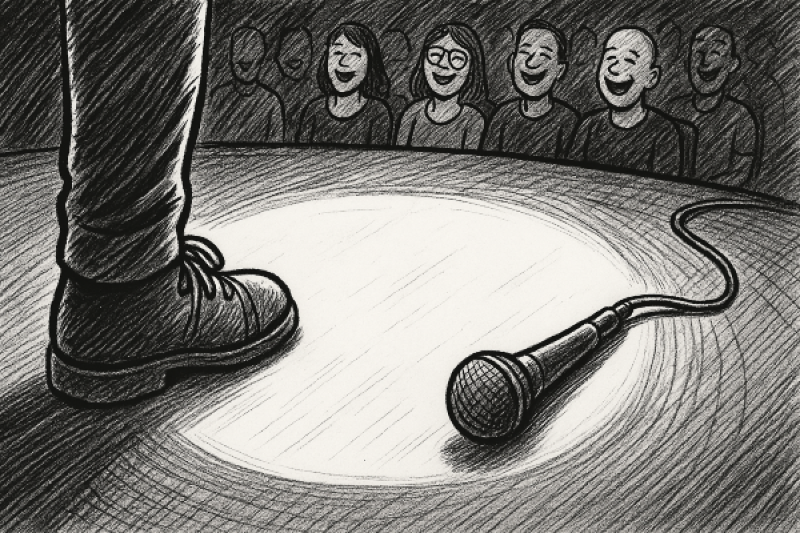
Start small. Don't even worry about getting laughs your first open mic. My only goal was to walk on stage. Take the mic out of the mic stand and say some of the things I prepared into it. Put the mic back in. Donesky. That is all. You're not getting signed to do a Netflix special on night one. This mic is for you and only you to take the plunge.
Be realistic. Typically, you will get in to comedy while also having a day job. It can take far more energy and courage to get out to your very first few open mics, especially late ones, than it will in the future on. The mainstream advice I've seen is to hit as many mics as you can as soon as possible. The advantage of this advice is that it is basically exposure therapy and you will get more comfortable on stage very quickly.
But the drawback is that it may not leave you with enough time to critically analyze your sets, rewrite your jokes, practice and experiment with performance and write new material. Some of you may have heard the expression: “Perfect practice makes perfect.” If you are reinforcing bad habits early on by not critically analyzing your work, you run the risk of building bad habits that will be much harder to break down the road.
When I first started, I started with a goal of one mic per week and then slowly upped it as I became more efficient. It's like training for a marathon. Most people don't go out their first day and run 26.2 miles. They build up to it.
Be consistent. The other local comics likely won't even pay any attention to you until they see you coming out consistently for months. So even if you are only doing one mic per week, keep doing that consistently.
If you are starting with one mic or two mics per week as described above, there are two options:
(1) Breadth: hit different mics each week
(2) Depth: hit the same mics each week.
There are pros and cons to both approaches. In option 1, you meet more people and get to experience different flavors of open mics. In option 2, you get to know the hosts and mic regulars much better and removes a lot of the scary variables of performing in an open mic, such as knowing how sign-up works, worrying about getting bumped and what type of audience to expect.
I don't know which is the right way but I personally went with the depth approach. There is a risk, of course, with not pushing yourself beyond your comfort zone. But as long as you remain cognizant of that risk, you will know when it is time to up your mic count or branch out to different ones.
Good luck my friend
A big part of having a growth mindset is that you are someone who enjoys the daily grind of learning and the journey of improvement. If this is you, and you don’t allow yourself to get too wrapped up in theoretical measures of success, you open yourself up to experiencing the joy of undergoing the transformational journey to becoming a comedian.
Ultimately, I know it will be scary and hard, but I promise you that if you don’t judge yourself too harshly at the start, you will improve exponentially in a short amount of time.
Member discussion